Most traders in the UK and across Europe spend months—sometimes years—searching for the 'perfect' strategy. They hop from one YouTube guru to another, test countless indicators, and convince themselves that the next system will be the one that finally works.
But here's the uncomfortable truth: your strategy isn't the problem. Your execution is.
I've trained hundreds of traders across London, Frankfurt, and beyond. The pattern is always the same. They understand supply and demand. They can spot order blocks. They know what liquidity grabs look like. Yet they still lose money.
Why? Because knowing what to do and actually doing it are entirely different skills.
The Execution Gap That Destroys Accounts
Let me paint a familiar picture. You're trading the London open—0800 GMT, markets are moving, EUR/USD is showing clear structure. You've identified your zone. You know where your entry should be. You even know your stop loss placement.
Then price approaches your level.
Suddenly, doubt creeps in. 'Maybe I should wait for more confirmation.' Or worse: 'This looks too obvious—it's probably a trap.' So you hesitate. Price triggers without you, runs 30 pips in your direction, and you're left watching profits you should have captured.
The next time, you overcompensate. You jump in early, without proper confirmation, and get stopped out on a wick. Now you're frustrated, emotional, and your trading discipline has completely collapsed.
This is the execution gap. And it kills more trading accounts than any faulty strategy ever could.
Why Discretionary Trading Fails Under Pressure
Here's what most educators won't tell you: discretionary trading—where you 'feel out' each trade based on current conditions—requires years of screen time to master. It demands you make complex decisions under pressure, often during the most volatile sessions.
For UK and European traders, this means making critical choices during the London session overlap with Frankfurt, when volatility spikes and price moves fast. Your brain isn't wired to handle that level of decision-making stress repeatedly without breaking down.
Discretionary approaches work for institutional traders who've spent a decade at a prop desk. For everyone else, they're a recipe for inconsistency, emotional trading, and blown accounts.
The Mechanical Alternative: Remove Emotion, Execute Consistently
This is why at FortitudeFX™, we built the Catch the Wick™ system around one core principle: mechanical execution.
A mechanical entry system means you follow a specific set of rules every single time. No interpretation. No gut feelings. No second-guessing. You either have your setup or you don't.
Let me show you exactly how this plays out in real trading conditions.
The 2 Candle. 1 Story.™ Framework in Action
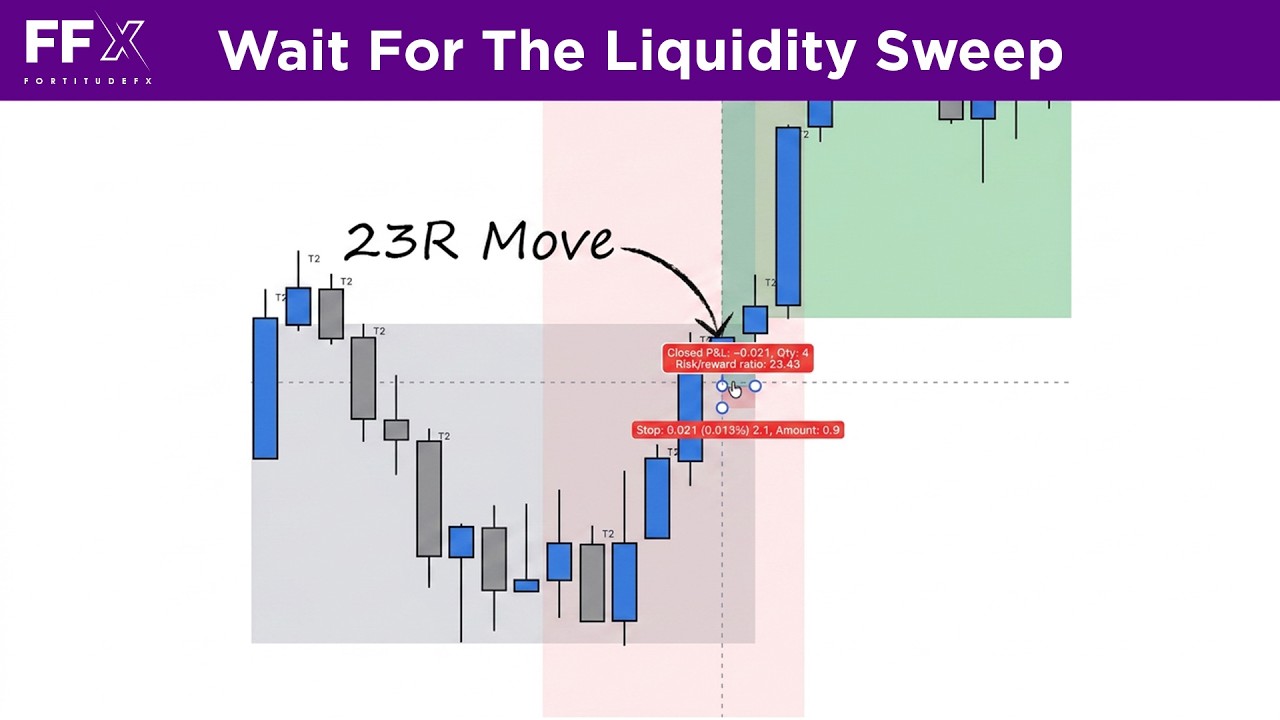
On 20th March 2025, during the London session, I identified a setup on GBP/USD using the exact mechanical process I teach. Here's the breakdown:
Step 1: Identify the momentum candle
I'm looking at my 15-minute chart. A large bullish momentum candle prints—this tells me trend direction is established on the lower timeframe. This isn't discretionary. It's visible, measurable, and objective.
Step 2: Mark the previous candle as my reference zone
I draw a box around this momentum candle. Everything I need to know about the next potential entry is contained within this box. I don't care about supply zones from yesterday's New York session. I don't care about demand levels from this morning's Asian range. That's noise.
For quick in-and-out traders—especially those of us in Europe working around London and Frankfurt sessions—historical zones from other sessions are irrelevant distractions.
Step 3: Wait for liquidity grab
I drop to the 1-minute chart. I'm watching for a liquidity sweep—a clear break and close beyond a recent swing low, followed by immediate rejection back inside range.
At 0847 GMT, I see it: price sweeps the swing low by 2 pips, then immediately reverses with a strong rejection wick. This is my liquidity grab. The trap is set, and I know exactly where my entry trigger sits.
Step 4: Place mechanical stop order
I place a buy stop order 0.5 pips above the rejection candle high. My stop loss sits 1 pip below the liquidity grab wick. Total risk: 2.1 pips.
No emotion. No hesitation. No 'what if' thoughts running through my head. The setup is valid according to my mechanical rules, so I execute.
Result: Price triggers my entry within three minutes and runs 48 pips before I trail out at 23R. That's a 23:1 risk-reward ratio from a 2.1 pip stop.
Now—could I have done this with discretionary 'feel' trading? Maybe. But the point is I didn't need to. The mechanical process removed all decision fatigue, all emotional interference, and delivered a clean execution.
Why Price Fractals Make This System Work Across Timeframes
One of the most powerful concepts European traders overlook is that price behavior is fractal. The same patterns that appear on a 4-hour chart appear identically on a 1-minute chart.
This means the Catch the Wick™ entry logic I apply on a 15-minute chart works exactly the same way on a 15-second chart. The principles don't change. Only the timeframe compression changes.
Why does this matter?
Because it allows you to refine entries to absurd precision. During the London morning session, I can identify a valid setup on the 15-minute, then drop to 15-second to fine-tune my entry within a 1-2 pip stop loss.
Let me give you a second example from the same trading day.
Refining Entries Using Fractal Structure
Later that morning, EUR/GBP printed a bearish momentum candle on my 15-minute chart during the 1000-1015 GMT candle. I marked my zone and dropped to 1-minute to watch for confirmation.
Here's what I saw: price pushed up into a supply zone I'd identified from the previous candle's rejection wick. But instead of reversing immediately, it consolidated. This is where most discretionary traders panic and either enter too early or miss the move entirely.
I stayed mechanical. I dropped to the 15-second chart.
On this compressed timeframe, I could see a clear demand zone forming from the initial rejection wick—the exact area where buyers had tried and failed. Price returned to this zone, grabbed liquidity above a minor swing high, then printed a strong bearish engulfing candle.
I placed my sell stop 0.5 pips below that engulfing candle. Stop loss 1 pip above the liquidity grab wick. Total risk: 1.8 pips.
Price never looked back. It dropped 34 pips over the next 40 minutes—a 19R trade from under 2 pips of risk.
This is not luck. This is mechanical execution applied with fractal precision across timeframes. And it's fully replicable once you understand the structure.
The Three Execution Killers (and How to Eliminate Them)
Even with a mechanical system, three execution errors still destroy trader accounts:
1. Hesitation at Entry Trigger
You see your setup. You know it's valid. But you wait 'just one more candle' for confirmation. Price runs without you. This is fear masquerading as caution.
Fix: If your mechanical rules say enter, you enter. Build a checklist. If all boxes tick, execution is non-negotiable. Trust the process or don't trade the system.
2. Moving Stops After Entry
Price moves against you by half a pip. You panic and move your stop further away 'just to give it room.' Now you've destroyed your risk-reward ratio and you're trading emotionally.
Fix: Your stop placement is part of your mechanical rules. It's set based on structure, not on your comfort level. If you can't stomach the stop distance, reduce position size—never move the stop.
3. Taking Profit Too Early
You're up 5R and your heart is racing. 'What if it reverses?' So you close at 6R when the trade had room to run to 20R. You've capped your winners and guaranteed you'll never achieve consistent profitability.
Fix: Set profit targets based on structure, not emotion. Use trailing stops according to your mechanical rules. Let the trade work. If you exit early three times and miss big runs, your psychology needs work more than your strategy does.
Why European Traders Need Systems Built for Their Sessions
If you're trading from the UK, Germany, or anywhere in the EU, you have a distinct advantage: access to the London session, the highest-volume forex window in the world.
But this also means you're trading during the most volatile, fast-moving part of the day. Discretionary decision-making during 0800-1000 GMT is nearly impossible for most retail traders. The speed and noise are overwhelming.
A mechanical system removes this problem entirely. You've done your analysis during the quieter pre-London hours. You've set your levels. When London opens and volatility spikes, you're simply waiting for your mechanical triggers—not trying to interpret price action in real time.
This is how professional traders operate. They plan the trade during low-stress periods, then execute mechanically during high-stress periods.
How to Build Execution Discipline
Knowing you need mechanical execution and actually implementing it are different challenges. Here's how to bridge that gap:
Create a physical checklist. Write down every condition that must be true before you enter a trade. Laminate it. Put it next to your monitor. Do not execute unless every box is checked.
Journal every trade. Not just results—document whether you followed your process. A winning trade that violated your rules is a bad trade. A losing trade that followed your rules perfectly is a good trade.
Backtest until pattern recognition becomes automatic. Spend 30 minutes daily reviewing historical charts, marking valid setups. When you've seen the pattern 200 times, execution hesitation disappears.
Start with tiny position sizes. Your first 100 mechanical trades should risk almost nothing. You're training execution behavior, not chasing profit. Once you can execute 50 trades in a row without rule violations, then increase size.
The Real Trading Edge Isn't What You Think
Every losing trader I've ever met thinks they need a better strategy. They're convinced the secret is some hidden indicator combination or a mythical pattern the pros use.
Every consistently profitable trader I know—including the institutional traders I've worked with in London—will tell you the same thing: edge comes from execution, not strategy.
Your ability to follow a proven process without deviation, trade after trade, week after week, is worth more than any 'perfect' strategy could ever be.
The Catch the Wick™ system works because it removes interpretation. It removes emotion. It removes decision fatigue. You see the pattern, you execute the process, you manage the trade according to structure.
That's it.
No guru predictions. No trying to outsmart the market. Just mechanical, emotionless execution of a proven edge.
If you're tired of knowing what to do but failing to execute consistently, it's time to stop blaming your strategy and start building execution discipline.
For further reading, see Two Candles. One Story. Why Simplicity Wins in Forex.
Join our free Discord community at https://discord.gg/fortitudefx where European traders share their mechanical setups daily, hold each other accountable to process over profits, and build the execution discipline that separates professionals from gamblers.
Your strategy probably isn't broken. Your execution is. Fix that, and everything changes.