You have spent months testing a trading strategy. The backtest results look strong. The logic is sound. You understand the setup, the entry trigger, the exit plan. Then you go live and within three weeks the strategy 'stops working'. You blame the system. You move on to the next strategy. You repeat the cycle.
This is not a strategy problem. This is a behaviour problem.
Most Traders Abandon Working Strategies Too Early
A mechanical trading edge does not win on every trade. It wins over a statistically meaningful sample - typically 50 to 100 trades minimum. Most traders do not reach that sample size because they cannot distinguish between a strategy drawdown and a broken strategy.
A drawdown is when the strategy produces a sequence of losses that fall within the expected statistical range of the system. If your strategy has a 60 percent win rate, losing 6 out of 10 trades is mathematically normal. It does not mean the strategy failed. It means variance is playing out exactly as designed.
A broken strategy is when the core market behaviour the system exploits no longer exists. If you trade liquidity sweeps and the pair you are trading stops respecting liquidity zones due to a structural shift in order flow, then yes - the strategy is broken. But this is rare. What is common is the trader breaking the strategy through inconsistent execution.
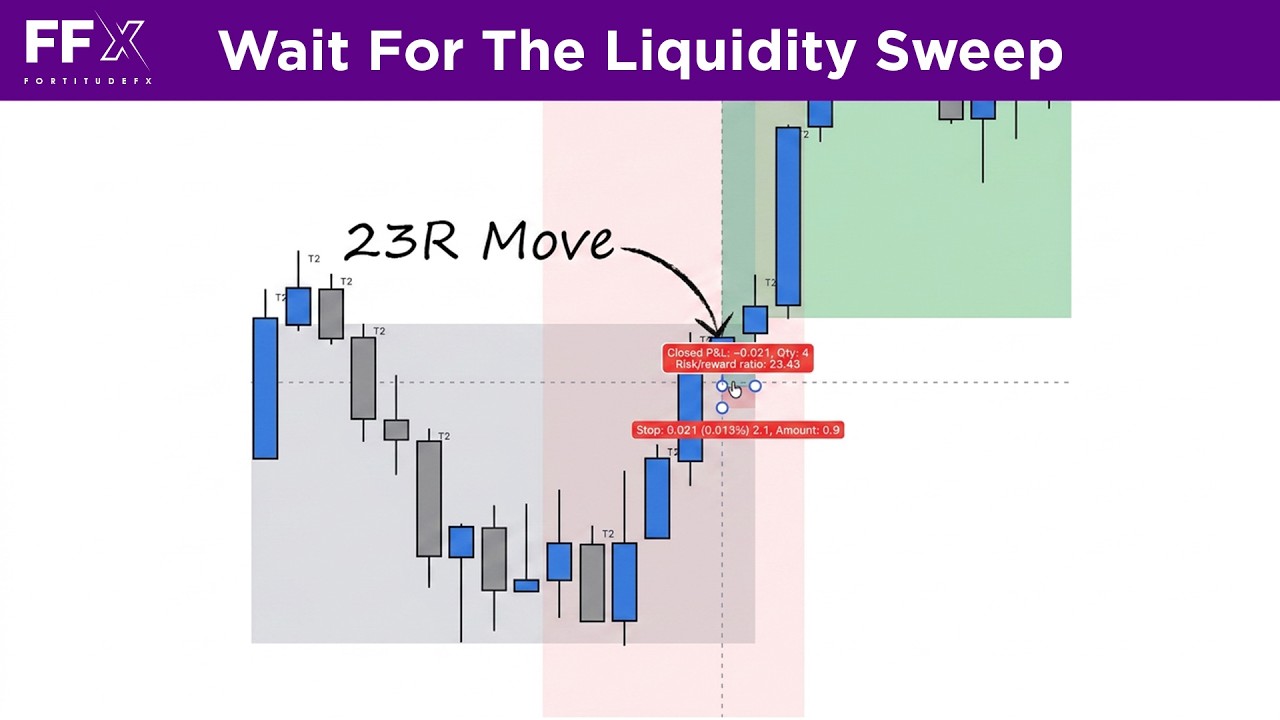
The FortitudeFX™ Catch The Wick™ framework is designed around one principle: remove execution discretion entirely. The 2 Candle. 1 Story.™ structure eliminates interpretation. You either have a valid momentum candle followed by a liquidity sweep or you do not. There is no grey area. This is not because discretion is inherently bad - it is because discretion introduces inconsistency, and inconsistency destroys edge.
The Moment You Add Discretion You No Longer Have a Mechanical System
You see a valid liquidity grab setup. The entry trigger prints. But this time the momentum candle looks 'too big'. Or the pullback feels 'too shallow'. Or you had two losses earlier today and now you are hesitant. So you skip the trade. Price runs 20R without you.
That override just broke your system.
The issue is not that you missed one trade. The issue is that you have now created permission for all future overrides. The next time you see a setup that makes you uncomfortable, your brain will recall that you skipped the last uncomfortable setup and nothing bad happened. In fact, you 'protected your capital'. You are now training yourself to trust discretion over system rules.
Within two weeks you are no longer trading the strategy. You are trading a version of the strategy filtered through your emotional state, your recent P&L, your confidence level that day. This is not mechanical trading. This is discretionary trading disguised as mechanical trading. And discretionary trading requires years of screen time to develop the pattern recognition and emotional regulation needed to succeed. You cannot shortcut that process by taking a mechanical system and selectively applying it when it 'feels right'.
The momentum candle continuation probability work we publish at FortitudeFX™ is built on thousands of observed setups. The edge exists because the rules are applied consistently. The moment you start filtering setups based on 'feel', you are trading a different system with different statistics. You no longer know your win rate. You no longer know your average R. You are flying blind.
A Failing Strategy Is Often Just a Failing Trader
There are three patterns that destroy otherwise profitable strategies: skipping valid setups, moving stop losses, and revenge trading after losses. All three stem from the same root cause - the inability to accept that individual trade outcomes are irrelevant.
Skipping valid setups happens when recent losses make you hesitant. You see the entry but you wait for 'extra confirmation'. By the time you convince yourself to enter, price has already moved and your risk-reward is ruined. Or worse - you skip the trade entirely and it becomes the 15R winner you needed to offset the previous three losses. You are now in deeper drawdown not because the strategy failed but because you did not execute it.
Moving stop losses is the most common form of self-sabotage. Price moves against you. You are certain the setup is valid so you give it 'a little more room'. You move your stop 5 pips lower. Price hits your original stop then reverses into profit without you. Or it hits your new stop and you take a loss 30 percent larger than planned. Either way you have broken the system. Your risk per trade is now unknown. Your position sizing is wrong. Your max drawdown calculations are invalid. One adjusted stop has cascading effects across your entire risk model.
Revenge trading after losses is when emotional regulation collapses entirely. You take a valid loss. Instead of moving on to the next setup, you force a trade that does not meet your criteria because you want to 'get back' what you just lost. This trade loses. Now you are down two trades and emotionally compromised. The next trade you take will be even worse. This spiral can erase weeks of disciplined trading in a single session.
The Catch The Wick™ 2-candle structure removes these decision points. You do not skip setups because the setup is binary - either the liquidity sweep occurred or it did not. You do not move stops because the stop is placed at the structural invalidation point defined by the previous candle wick. You do not revenge trade because there is no discretion in setup identification - if the next candle does not print a momentum move with a valid liquidity grab, there is no trade. The system forces you to wait.
Key Takeaways
- Edge exists over sample size, not individual trades. If you cannot execute 50 consecutive setups without overriding the rules, you do not know if the strategy works. You are testing your discipline, not the system.
- One override creates permission for all future overrides. Mechanical systems only work when applied mechanically. The moment you introduce discretion you are trading a different strategy with unknown statistics.
- The three killers are skipping setups, moving stops, and revenge trading. All three stem from inability to accept that single trade outcomes are meaningless. Your job is to execute the process. The market decides the outcome.
- FortitudeFX™ trades are designed to remove decision points. The liquidity sweep and demand zone structure is binary. You either have the setup or you do not. There is no room for 'feel'.
- If your strategy is failing, record your last 20 trades. Note every time you skipped a valid setup, adjusted a stop, or took a non-system trade. The problem will be obvious.
Your strategy is not failing. You are failing to execute the strategy. The distinction matters because one is fixable and the other sends you back to searching for the next 'holy grail' system that does not exist.
For further reading, see Match Your Trading Strategy to Your Personality and Lifestyle.
For further reading, see Catch The Wick™ Bootcamp: Mechanical Forex Trading for SEA/Asia.
For further reading, see Catch the Wick Bootcamp: Learn Mechanical Forex Trading.
For further reading, see Two Candles. One Story. Why Simplicity Wins in Forex.
For further reading, see The Only Forex Risk Management Rules That Matter.
If you want to learn how to trade the Catch The Wick™ system with zero discretion and full mechanical clarity, join the free FortitudeFX™ Discord community where we break down live setups daily and show you exactly how execution discipline turns a simple two-candle pattern into a consistently profitable edge: https://discord.gg/fortitudefx