Most traders overcomplicate their approach to markets. They layer indicators, obsess over multiple timeframes, and struggle with inconsistent decision-making. The reality is that trading can be systematic, mechanical, and repeatable for decades if you understand how price actually moves.
This article breaks down a simple momentum candle structure framework that focuses on what matters: reading candles, understanding wicks, and identifying high-probability entries without the noise.
The Foundation: Momentum Candles and Structure
Everything begins with momentum candles. These are candles that signal a clear directional bias based on how aggressively price moves. When you see a momentum candle, you are not guessing. You are reading what the market is already showing you.
On a 15-minute chart, a momentum candle often signals that structure has already shifted on lower timeframes like the 1-minute. If structure breaks to the downside internally, that momentum candle becomes your confirmation. You do not need to analyze the 4-hour chart, daily levels, or complex confluences. Your job as a day trader is to get in, get out, and focus on what is happening right now.
Once you identify a momentum candle that breaks structure, you mark it. You do not place trades randomly. You wait for specific price behavior within that candle's range.
Why Wicks Matter More Than You Think
Most traders ignore wicks or treat them as meaningless rejection. That is a mistake. Wicks tell you where liquidity was swept, where imbalances exist, and where price is likely to react.
When a wick forms on a bullish candle during a bearish momentum shift, it is not just rejection. It is the market balancing itself. Price moves up to fill gaps, sweep liquidity, and then continues in the dominant direction. If you do not understand this, you will enter trades too early or in the wrong direction entirely.
For example, if you see a bullish internal structure forming and place a long order block trade, you are likely stepping into a trap. Price may break higher temporarily, tag your entry, and immediately reverse. That is not bad luck. That is a lack of understanding about how wicks and liquidity sweeps function within momentum candles.
The key is to wait for the wick to form, identify the liquidity sweep within the range, and then execute your entry. This is not prediction. This is reaction based on structural evidence.
The Blue Box Method: Simplified Entry Logic
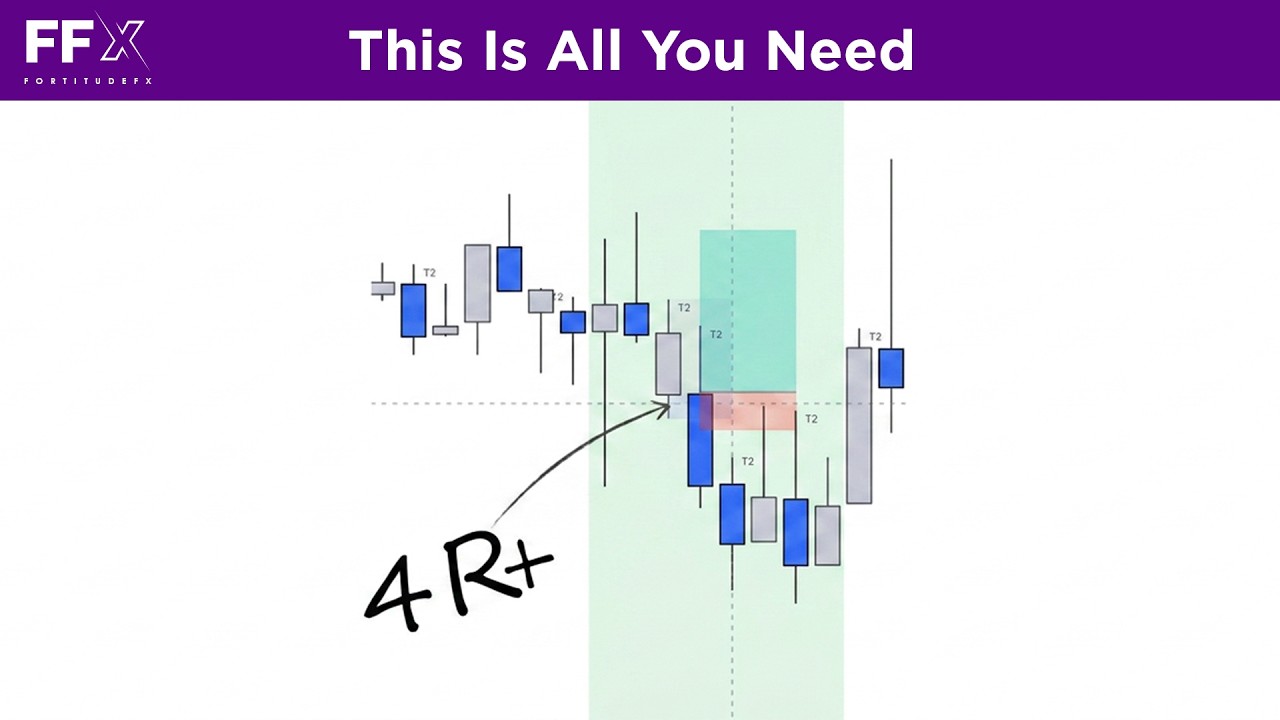
The approach is simple. Once you identify your momentum candle, you draw a box around the first candle where the wick has not yet printed. Everything outside that box is irrelevant. You are only interested in what happens inside that range.
Within that range, you watch for one liquidity sweep. This is the first time price taps into a key level within the box and reacts. After that sweep, you prepare your entry.
If price breaks above the range after your initial entry setup, you cancel and wait for the next sweep. You do not chase. You do not force trades. You wait for the structure to confirm your bias again.
In practice, this might mean placing a short after the first liquidity sweep, watching price attempt to break higher, canceling that order, and then re-entering when price sweeps again and confirms continuation. Your stop loss sits just above the wick high, often two to three pips. Your target is based on the next structural level or supply zone.
This method produces high reward-to-risk setups because you are entering at the exact point where price has shown its hand. You are not guessing. You are responding to what the market has already done.
For more on how to execute mechanical entries like this, explore the FortitudeFX Bootcamp, where every entry model is broken down in full detail.
Trap Entries and How to Avoid Them
One of the most common mistakes is entering too early based on internal structure breaks that go against the dominant momentum. If you see a bullish break on a lower timeframe but the higher timeframe momentum is bearish, you are likely looking at a trap.
These traps occur because traders react to the first sign of structure without waiting for confirmation. They see a break of structure, place a limit order at an order block, and expect price to continue. Instead, price taps them in, reverses immediately, and continues in the original direction.
The way to avoid this is to prioritize the momentum candle over internal structure. If the momentum is bearish, you are only looking for shorts. If internal structure breaks bullish temporarily, you treat that as a liquidity event, not a reversal signal.
Wait for the wick. Wait for the sweep. Then enter. Do not enter before the wick forms. Do not enter before the sweep happens. Patience is the filter that separates winning trades from losing trades.
Reading Supply and Demand Within the Framework
Supply and demand zones still matter, but only within the context of momentum and wick structure. If price taps into a supply zone after a momentum candle forms, that is additional confirmation. It is not the entry trigger itself.
In one example, price moved up into a clear supply zone, swept liquidity at the high, and then melted down for over ten hours of downside movement. That was not luck. That was the result of reading momentum, waiting for the wick, and entering after the liquidity sweep.
You do not need to predict where price will go. You need to recognize where price has already shown its intention and react accordingly. That is the difference between mechanical execution and emotional gambling.
For a deeper breakdown of how liquidity, structure, and momentum align, visit the FortitudeFX blog, where you will find additional case studies and real trade examples.
Why This Approach Works Long-Term
This framework works because it removes subjectivity. You are not relying on feelings, opinions, or predictions. You are following a repeatable process that triggers only when specific conditions are met.
Momentum candle forms. Structure breaks. Wick prints. Liquidity sweep occurs. Entry is placed. Stop loss is tight. Target is logical. Every step is defined. Every decision is based on observable price behavior.
This is how you build consistency. This is how you survive in markets for decades. You do not need to be smarter than the market. You need to be more disciplined than your emotions.
Traders who struggle with profitability, mindset, and inconsistent strategies often lack a mechanical system. They trade based on feelings, tips, or incomplete setups. The result is random performance and emotional exhaustion.
When you trade mechanically, you remove that variability. You know exactly what you are looking for. You know exactly when to enter. You know exactly when to exit. There is no room for second-guessing because the system tells you what to do.
For further reading, see Match Your Trading Strategy to Your Personality and Lifestyle.
Join the FortitudeFX Community
If you are serious about learning this approach, the FortitudeFX community is the place to start. Whether you are interested in the full Bootcamp, the VIP Discord, or simply want to connect with other disciplined traders, you will find a group focused on mechanical execution, emotional control, and long-term consistency.
The free Discord is open to anyone looking to improve their trading process. Join the conversation at discord.gg/fortitudefx and start learning how to trade with structure, patience, and precision.