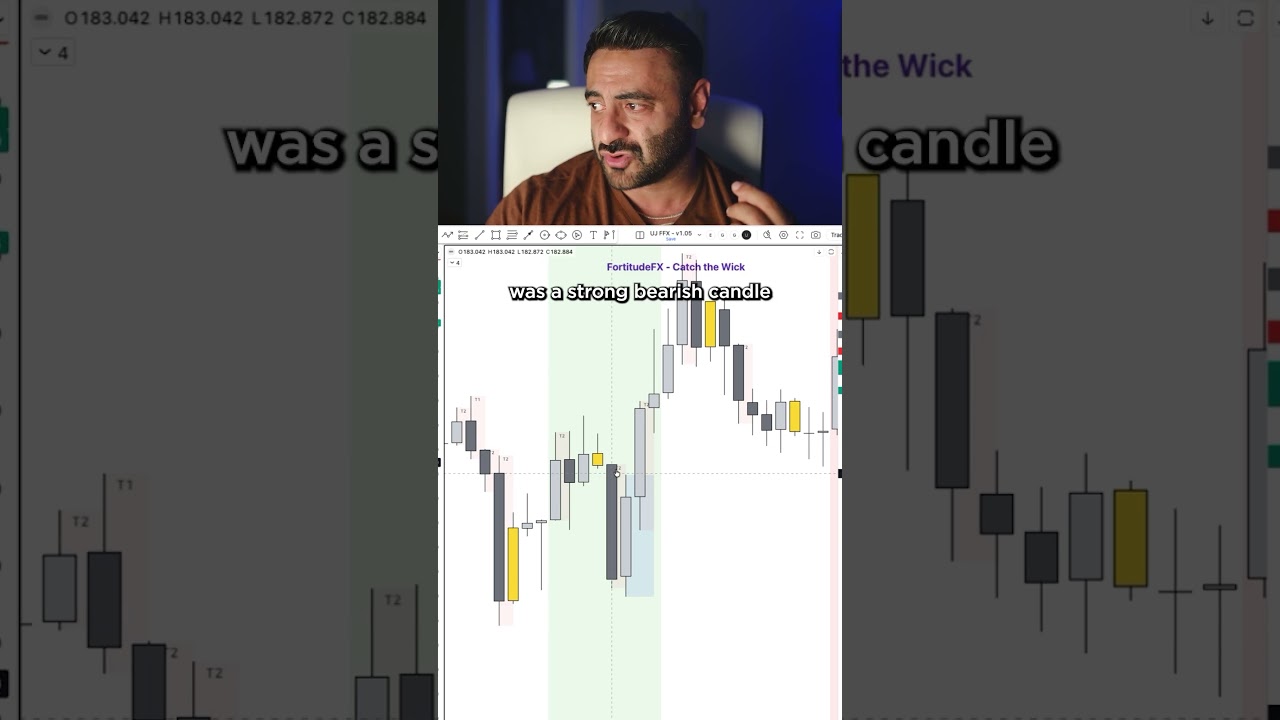
The first momentum candle tells you everything you need to know about market bias. This is not opinion — this is observable price behavior that GCC traders can verify on any chart, any session, any pair.
When you see a strong bullish or bearish momentum candle, the probability that the next candle continues in that direction is exceptionally high. Not guaranteed, but high enough that professional traders build entire strategies around it.
This is Salman, founder of FortitudeFX™, and in this article I will walk you through why momentum begets momentum, how to read continuation probability, and how this principle integrates directly into the Catch the Wick™ mechanical entry system.
What Is a Momentum Candle
A momentum candle is a candle with a large body relative to recent price action. It shows conviction. It shows institutional participation. It shows that one side of the market — buyers or sellers — has taken control.
In the GCC region, momentum candles are most visible during the London open (11:00 AM to 1:00 PM GST) and the New York session overlap (4:00 PM to 6:00 PM GST). These are the hours when volume enters the market and directional moves begin.
If you trade EUR/USD, GBP/USD, or USD/JPY during these windows, you will see momentum candles form regularly. The question is not whether they appear — the question is whether you recognize them and whether you understand what comes next.
Momentum Candles Predict the Next Candle
Here is the core insight: if a candle is long, the following candle is also likely to be long in the same direction. This is not speculation. This is how trends form.
Trends do not start with hesitation. They start with momentum. A strong bullish candle signals that buyers have entered. The next candle, statistically, will continue bullish because those same buyers are still in the market, and new buyers are now entering on confirmation.
I welcome you to open your charts right now and verify this. Look at any trending move. You will see that the first momentum candle is followed by continuation candles. Yes, reversals happen — but they are the exception, not the rule.
Probability Is Not Certainty
Let me be clear: I am not saying every momentum candle continues. I am saying the probability is high — perhaps 95%, perhaps 97%. I put my money on that probability because over hundreds of trades, that edge compounds.
In the transcript, I mentioned a strong bearish momentum candle that reversed. That is fine. That is part of trading. But notice what happened: there was no valid Catch the Wick™ setup on the bullish reversal candle. The system filtered out the low-probability trade.
This is why mechanical rules matter. You do not chase every candle. You wait for confirmation. You wait for structure. You wait for the wick to form in alignment with momentum.
How GCC Traders Should Read Momentum Bias
If you are trading from Dubai, Riyadh, or Doha, your active trading hours align perfectly with the London session. This is when momentum candles form on the major pairs.
When you see a strong bullish momentum candle at 11:30 AM GST, your bias for the next candle should be bullish. You are not hoping — you are aligning with probability. You are positioning yourself with the institutional flow that created that momentum in the first place.
This does not mean you enter immediately. It means you prepare to enter on the next confirmation candle if it meets your Catch the Wick™ criteria: a wick rejection in the direction of momentum, a closed body, and a clear risk-to-reward setup.
Why Continuation Is More Likely Than Reversal
Price does not reverse without reason. Reversals require a shift in sentiment, a fundamental catalyst, or a technical level that halts momentum. In the absence of those factors, continuation is the path of least resistance.
When a strong momentum candle forms, it indicates that institutional money has entered. Institutions do not enter and exit within one candle. They build positions across multiple candles. This creates follow-through.
Retail traders often try to pick tops and bottoms. They see a strong bullish candle and think it is overextended. They short into momentum. This is how accounts are destroyed. Professional traders do the opposite — they align with momentum and wait for confirmation.
The Role of the Second Candle
The second candle is critical. If the first candle shows momentum, the second candle shows whether that momentum is sustainable.
If the second candle also closes bullish with a strong body, you have confirmation. The trend is forming. The probability of continuation on the third candle is now even higher.
If the second candle closes as a doji or a reversal candle, the momentum has stalled. This is not a failure — this is information. You do not enter. You wait for the next momentum candle to form.
How This Fits Into Catch the Wick™
The Catch the Wick™ system is built on this exact principle. We do not enter on momentum candles themselves — we enter on confirmation candles that follow momentum and show rejection wicks.
Here is the sequence: strong momentum candle reveals bias. You wait. The next candle forms. If it has a wick in the direction of the previous momentum and closes with a body in that same direction, you have a valid setup.
This is mechanical. This is repeatable. This is how GCC traders can build consistency without relying on discretion or emotion.
For further reading, see Fractal Trading Strategy Across Multiple Timeframes.
For a full breakdown of the Catch the Wick™ entry rules, visit our free bootcamp or join the discussion in our free Discord community.
What Happens When Momentum Fails
Sometimes the momentum candle does not continue. The next candle reverses. This is fine. This is part of the game.
The key is that you did not enter on the momentum candle itself. You waited for confirmation. If confirmation does not come, you do not trade. You preserve capital. You wait for the next opportunity.
This is the difference between gambling and trading. Gamblers chase. Traders wait. Patience is the edge.
Volume and Momentum
Momentum candles are most reliable when they occur during high-volume sessions. In the GCC, this means the London session and the London-New York overlap.
During low-volume hours — such as the Asian session or late New York — momentum candles can be false signals. Price can spike without follow-through because there is no institutional participation.
Always consider session context. A strong momentum candle at 11:00 AM GST is more reliable than the same candle at 3:00 AM GST.
Case Study: EUR/USD During London Open
Let us say you are watching EUR/USD on a Wednesday morning. At 11:15 AM GST, a strong bullish momentum candle forms. The body is twice the size of the previous three candles. The close is near the high.
Your bias is now bullish. You do not enter yet. You wait for the next candle.
The next candle opens, pulls back slightly, and then closes bullish with a wick at the bottom. This is a Catch the Wick™ setup. You enter long at the open of the third candle, with your stop below the wick of the second candle.
Price continues bullish for the next three candles. You exit at your target. This is not luck — this is probability playing out as expected.
Common Mistakes GCC Traders Make
Many traders see a momentum candle and enter immediately. They do not wait for confirmation. They get stopped out when the next candle pulls back to retest support.
Other traders ignore momentum entirely. They trade against it, hoping for a reversal. They short into bullish momentum or buy into bearish momentum. This is low-probability trading.
The correct approach is to acknowledge momentum, wait for confirmation, and enter only when structure aligns with probability.
How to Practice This
Open your charts. Mark every strong momentum candle you see. Then observe the next three candles. Note whether they continue in the same direction or reverse.
Do this for 50 candles. You will see the pattern. You will see that continuation is far more common than reversal. You will see that the Catch the Wick™ system is built on observable, repeatable price behavior.
For more practical examples and live chart reviews, explore our trading blog or join the conversation in our Discord server.
Final Thoughts
Momentum candles are not random. They are signals. They tell you where the market is likely to go next. They give you a probabilistic edge.
As a GCC trader, you have the advantage of trading during the most liquid sessions. You see momentum candles form in real time. The question is whether you have the discipline to wait for confirmation and the patience to let probability work in your favor.
This is the foundation of the Catch the Wick™ system. This is the foundation of 2 Candle. 1 Story.™ This is how you trade with structure, not hope.
If you are ready to learn the full mechanical entry system, join our free bootcamp. If you want to discuss setups in real time with other GCC traders, join our free Discord community. We are building a community of disciplined, probability-focused traders. You are welcome to be part of it.