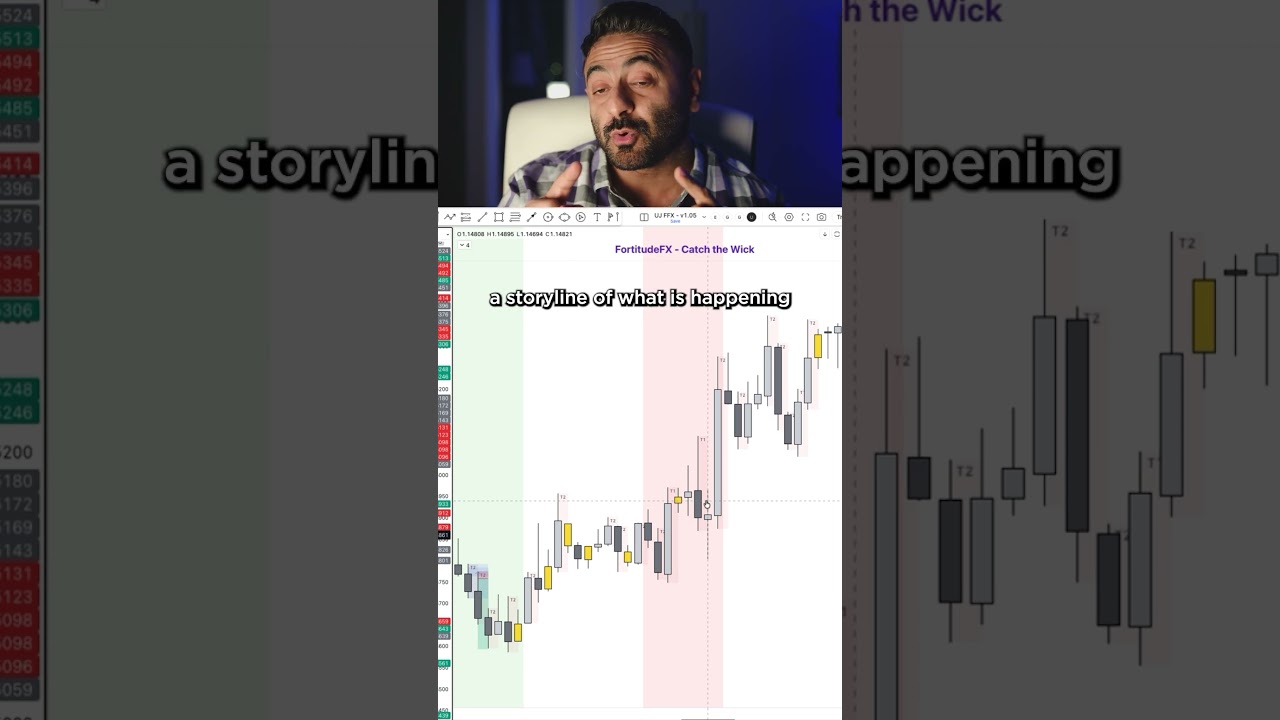
There is a moment in every trade where the market shows its hand. Most traders miss it because they are watching the wrong part of the candle.
They wait for the close. They look for confirmation. They want to see the candle finish before they decide what it means.
By then, the trade is already gone.
The open candle is not just a starting price. It is a declaration of intent from institutional order flow. It is the first half of a two-candle story, and if you know how to read it, you can position yourself before the retail crowd even realizes what happened.
This is how Catch The Wick™ reads the open candle. This is what most traders miss.
The Open Candle Is Where The Trap Is Set
Retail traders are trained to focus on the close. They look for bullish or bearish candles. They wait for patterns to complete. They need the candle to finish before they feel safe entering.
That is the problem.
Institutional players do not wait for confirmation. They set the open. They use the open candle to establish position, to signal intent, and to set the stage for the wick that will form in the next candle.
The open is where the trap is set. The close is where retail walks into it.
In the Catch The Wick Bootcamp, we teach that every trade begins with a two-candle story. The first candle establishes the narrative. The second candle gives you the entry. And the open of that first candle is the most important piece of information you can get.
Here is what the open candle tells you:
- Where institutional flow is positioned
- Whether the previous range is being defended or abandoned
- What the expected direction is before the wick forms
If you ignore the open, you are reading the story backwards.
How The Open Candle Works Inside The CTW Framework
The Catch The Wick™ system is built on the idea that price moves in two-candle sequences. The first candle sets up the story. The second candle gives you the entry through the wick.
But the first candle is not just about where it closes. It is about where it opens.
A valid open candle inside the CTW framework has three characteristics:
1. It opens at a decision point. The open should occur at a level where institutional players are making a choice—support, resistance, a prior wick, or a key liquidity zone. If the open is random, the story is weak.
2. It establishes directional bias without retail confirmation. The open candle should move in a way that institutional flow is clear, but retail has not yet piled in. This is the gap between intent and confirmation. This is where you get positioned.
3. It sets up the next candle's wick. The open candle should create the conditions for a wick to form in the next candle. If the open candle closes strong and clean, there is no wick coming. If it closes weak but opens strong, the wick is being prepared.
This is not about guessing. This is about reading order flow in real time.
Most traders wait for the close because they want certainty. The CTW system teaches you to read the open because that is where the edge is.
The Time Fractal Connection: Why The Open Candle Needs Alignment
The open candle does not work in isolation. It works because it is aligned across timeframes.
This is what we call the time fractal inside the Catch The Wick™ methodology. The same two-candle story that plays out on the 15-minute chart is being confirmed or invalidated on the 1-minute chart in real time.
Here is how it works:
On the 15-minute chart, you see the open candle form. It opens at a key level. It establishes directional bias. You are now waiting for the second candle to give you the wick entry.
But you do not just wait. You drop down to the 1-minute chart and watch the fractal unfold.
Inside that 15-minute candle, you have 15 one-minute candles. Those 1-minute candles are telling you the story in granular detail. They show you whether the open is being defended. They show you where the wick is forming. They show you where the institutional order flow is stepping in.
If the 1-minute fractal confirms the 15-minute open, you have alignment. If it does not, you have divergence, and the trade is invalid.
This is why the time separation between 15-minute and 1-minute works so well. You have enough candles inside the larger timeframe to give you a storyline. You have enough information to make a decision before the 15-minute candle closes.
If you use a 15-minute and a 10-minute chart, you lose that separation. You do not have enough information. If you use a 15-minute and a 14-minute chart, they are essentially the same. There is no fractal.
The 15-minute and 1-minute combination gives you the balance between context and execution. The open candle on the 15-minute gives you the narrative. The 1-minute fractal gives you the confirmation and the entry.
Most Traders Enter Late Because They Wait For The Close
Here is what happens when you ignore the open candle.
You wait for the first candle to close. You see a bullish candle. You think the trend is confirmed. You enter on the second candle as it breaks higher.
Then the wick forms. Price reverses. You get stopped out.
You were not wrong about the direction. You were just late. You entered after the institutional players had already positioned themselves. You entered after the trap was set.
The open candle would have told you what was coming. It would have shown you where the real order flow was. It would have given you the setup before retail confirmation arrived.
This is why retail traders chase. This is why they get stopped out. They are waiting for certainty when they should be reading intent.
The Catch The Wick Bootcamp teaches you how to read the open candle as part of the two-candle story. You learn to see the setup before it completes. You learn to position yourself where institutional flow is moving, not where retail is reacting.
How To Use The Open Candle In Your Trading
If you want to start using the open candle inside your trading process, here is how to apply it:
Step 1: Identify the decision point. Before the candle opens, know where the key levels are. Know where support and resistance sit. Know where prior wicks have formed. The open candle should occur at a level that matters.
Step 2: Watch how the candle opens. Does it open strong or weak? Does it open inside the range or outside it? Does it gap or does it continue smoothly? The character of the open tells you whether institutional flow is engaged.
Step 3: Drop to the 1-minute fractal. As the 15-minute candle is forming, watch the 1-minute candles inside it. Are they confirming the open? Are they forming a wick? Are they setting up the second candle entry?
Step 4: Wait for the wick on the second candle. The open candle sets up the story. The second candle gives you the entry. Do not enter until the wick forms and the fractal confirms.
This is not complicated. It is just different from what most traders are taught.
Most traders are taught to wait. The CTW system teaches you to read.
The Open Candle Is The First Half Of The Story
Trading is not about predicting the future. It is about reading the present with clarity.
The open candle is the first half of the story. It tells you where institutional flow is positioned. It tells you what the market is setting up. It tells you where the wick is likely to form.
If you ignore it, you are trading blind. You are reacting instead of positioning. You are entering late instead of getting in early.
The Catch The Wick™ system is built on the idea that every trade begins with 2 Candles. 1 Story.™ The open candle is where that story starts.
For further reading, see Why This Trading Strategy Works on All Timeframes.
If you want to learn how to read the open candle, how to align it with the time fractal, and how to use it inside the full CTW framework, join the Bootcamp or get access to the full breakdown and live trade examples inside the VIP Discord.
For further reading, see The Opening Candle Continuation Setup: Why the First Candle Sets the Entire Session's Direction.
You can also start for free. Join the FortitudeFX community at https://discord.gg/fortitudefx and see how we apply this in real time.
The market is telling you a story. You just have to know where to start reading.